

· Port fee showdown postponed as US and China return to talks
China’s stock market climbed to decade highs on Thursday as presidents Donald Trump and Xi Jinping met for the first time in six years — with one major outcome for shipping being the suspension of new port fees both countries had introduced earlier this month.
The United States has postponed higher port charges on Chinese- built vessels, a move initially aimed at challenging Beijing’s dominance in global shipbuilding. The delay follows the rollout of reciprocal port fees by both countries on October 14, which marked the first time port charges had been used as geopolitical tools rather than traditional trade tariffs.
“We’re going to postpone that while we negotiate with them about that issue,” US Trade Representative Jamieson Greer told reporters aboard Air Force One following the Trump–Xi meeting in Busan on Thursday. “We’re trying to rebuild shipbuilding,” he added, signalling a desire to address the issue through dialogue rather than escalation.
The fees, introduced by both Washington and Beijing, were structured around a vessel’s ownership, operation, flag, and place of build — a design that industry players said blurred traditional definitions and created uncertainty across the maritime sector.
Marine insurer Gard noted that the lack of clarity in charterparty clauses could spark disputes over who bears the cost. “Owners will argue the fees arise because the vessel is ordered to that port, while charterers will say it’s due to the ship’s characteristics or ownership,” Gard said in an advisory.
Industry associations have already started responding. Intertanko and BIMCO have published owner-friendly clauses to address liability for the US-imposed fees, and new wording to cover China’s reciprocal charges is said to be in the works.
While the postponement offers a short-term reprieve for shipowners, it does not resolve the wider question of whether such differential port charges could become a longer-term feature of maritime trade policy. For now, the focus turns to negotiations
— and whether the thaw in Busan will last long enough to
calm one of the shipping industry’s newest and most unusual flashpoints, something that has already seen two of Hong Kong’s largest shipowners – Pacific Basin and Seaspan – relocate to Singapore to avoid the aggressive American fees.
· Surging VLCCs enter ‘pick a number’ territory
VLCCs roared well into six-digit territory yesterday, lending credence to projections by sister title Splash Extra that suggest 2025 is on track to be the best year for overall tanker earnings for a decade.
The TD3C route from the Middle East to Asia leapt by $37,000 yesterday to $125,100 as shipowners capitalised on extremely tight vessel availability.
“Charterers were squeezed, sometimes receiving only one vessel quote for a given date, resulting in many available ships quickly disappearing,” analysis by SEB, a Swedish bank, relayed. Activity from the US Gulf also surged, driving rates up to $13m and extending bookings well into December.
“With still some uncovered cargoes remaining in the [Arabian Gulf] for the middle of the month, rates are expected to be heavily tested due to the scarcity of open ships,” SEB suggested.
Analysts at Jefferies, an American investment bank, see continued strength for VLCCs in the coming months. VLCCs have now eclipsed their previous highs seen this cycle, when they peaked at around $115,000 a day in November 2022 and again in March 2023, according to Jefferies.
“The short-term supply/demand picture in the [Middle East Gulf] is now not far off 1:1 and we are approaching a ‘pick a number’ territory,”
“Attempts to talk about things balancing further out on the curve are met with a deaf ear by the owning community,” analysts at Fearnleys suggested, concluding: “Winter is coming!”
· Shipping tests the Red Sea again
Shipping is still very cautious about a wholesale fleet pivot back to the Suez Canal, but ship trackers are keeping a firm eye on a couple of vessels tiptoeing back to a region that has been off limits for many thanks to the Houthis from Yemen campaign against merchant shipping in support of Palestinians in Gaza.
French containerline CMA CGM is sending two 17,859 sister ships,
the CMA CGM Benjamin Franklin and the CMA CGM Zheng He, from Europe to Asia via the Suez on the Ocean Alliance’s NEU4 service, marking the first alliance service return to the Red Sea since the end of 2023.
Meanwhile, the sanctioned Russian LNG tanker, Arctic Metagaz, currently in the Gulf of Aden heading west, is also a vessel that ship trackers are keeping an eye on. The 138,028 cu m vessel is likely to be the first LNG carrier to transit the Suez in eight months.
Another sanctioned Russian ship, the 21-year-old Komander, an aframax, made headlines in the Suez earlier this week. The crude oil tanker experienced engine trouble and briefly ran aground on Tuesday near the 48 km mark of the canal.
A tentative ceasefire between Israel and Hamas reached at the start of the month has led to speculation that more ships might return to the Red Sea. The Houthis have long justified their strikes on commercial vessels as solidarity with Palestinians — over 100 attacks since late 2023.
Ship operators and insurers will now be watching carefully to see if the militant group scales back operations in the Red Sea and the Gulf of Aden, as previous conditional pauses were tied to earlier Gaza ceasefires. There have been no Houthi attacks on ships so far this month, but Israel has resumed attacks in Gaza.
Egypt, meanwhile, has said it is developing plans for the resumption of trade through the Suez Canal.
· Indian PM officially launches Bharat Container Line
India has officially announced its first national container shipping line — Bharat Container Shipping Line (BCSL) — marking a major step in the country’s plan to reduce dependence on foreign carriers and boost control over its seaborne trade.
Prime Minister Narendra Modi announced the creation of BCSL at the Global Maritime CEO Forum during India Maritime Week 2025 in Mumbai, describing it as part of India’s “new era of maritime confidence.”
The new line starts with a fleet of 51 boxships, backed by a $6.9bn investment. It will operate under a public–private partnership, supported by India’s Maritime Development Fund, and will focus initially on regional routes across Asia, West Asia, and the Red Sea, before expanding to global trades.
The launch of BCSL aligns with the government’s long-term goal to build a strong domestic shipping presence capable of handling a greater share of India’s growing containerised trade — much of which is currently carried by foreign operators.
During his address, Modi said India’s maritime sector was “advancing with great speed and energy,” highlighting record investments and policy reforms designed to transform the country into a global maritime hub.
As part of the same event, Modi unveiled a string of major state- backed shipping orders, including nearly 60 oil and gas vessels worth around $5.7bn, launch of a “Green Tug Programme” involving 100 eco-friendly tugs and 11 dredgers for Dredging Corporation of India.
In total, the announcements covered 437 new vessels worth a combined $26bn — part of the government’s wider “Maritime India Vision 2047” initiative.
The Prime Minister also confirmed that Shipping Corporation of India (SCI) plans to expand its fleet to 216 vessels by 2047,
underscoring India’s long-term push for maritime self-reliance and fleet renewal.
· ‘Tax Me’ protest targets coal ship named Climate Justice in Newcastle
A two-year-old kamsarmax belonging to Safe Bulkers became the centre of an environmental protest today at the world’s largest coal exporting port.
This morning in Newcastle, Australia, members of climate justice group Rising Tide painted on the Climate Justice ship the words ‘Tax Me’ to call on the federal government to introduce a 78% fossil fuel export profits tax to fund a community and industrial transition away from polluting coal.
The port of Newcastle hit out at the protest, saying that the actions were dangerous.
Alexa Stuart, a Rising Tide spokesperson, said: “It is laughable that a coal ship is called Climate Justice when the burning of fossil fuels is the number one driver of dangerous climate change which is already causing devastating impacts on innocent people all around the world.
Rising Tide is planning a blockade of the port next month.
Preparing for less business from its main client, China, the port of Newcastle is actively pursuing diversification strategies to reduce its reliance on the black fossil fuel.
With coal accounting for 95% of its cargo volume and 72% of revenue, the port has set a goal to increase non-coal revenue to 50% by 2030.
Central to this transformation is the development of a deepwater container terminal and a 220 ha Clean Energy Precinct on Kooragang Island. The precinct aims to support the production and export of green hydrogen and ammonia, backed by federal investment.
· Shipping needs a stress test
Few in global shipping matched Dr Helmut Sohmen’s mix of intellect, caution, and commercial courage. As markets hum and new bubbles form, his advice to hoard cash and expect the unexpected feels freshly urgent, writes Andrew Craig-Bennett.
Dr Helmut Sohmen has died, full of esteem and honours, having inherited an empire, expanded it, and passed it on in good order, which are not easy things to do.
He once remarked that the revolution in shipbuilding had caused a permanent oversupply of ships. Setting up the first modern shipyard in a country is hard (been there, done that thing, got the tshirt!) but setting up the 15th is easy. We all know now that shipyards can be called into existence anywhere and if the place chosen can obtain components and steel plate at reasonable cost then a competitive shipyard can be created. This is a permanent change in the shipowning business.
We are used to the idea that banks are stress tested to assess their ability to withstand financial shocks. Living, as we are, in interesting times politically and economically, and knowing as we do that financial shocks lead instantly to shipping shocks, would it be a wise idea for shipping companies to stress test themselves?
Invest now, and make the most of the boom, or keep a cash pile for a rainy day, and for the opportunities that come with a rainy day for those who do have cash? We all know that the real big wins are made by
companies that have cash to spend on ships as the bottom of a recession comes to an end. Everyone wants to be the last man standing. Being that man is very hard, and going too soon eats up working capital faster than anyone cares to think about – that’s the part that people forget.
There is no right answer for the directors of a shipowning company, but it is a pity for a shipowner, dependent as shipowners are on information discontinuities and alert to them, to be overwhelmed by the unforeseen.
Examples from the strange death of British shipping come to mind; there were the tramp owners in the 1940’s who collected their pay outs for their war losses, looked at the numbers of Liberties, Victories and T2s around and at the rush to order new from the shipyards, and decided to wait until shipyard prices came down before ordering.
That was the first time when owners would buy an engine and then look for a shipyard – something that happened again more recently. Prices never did come down and some owners gave up, quietly, and never returned to shipowning. They missed the bus.
At present, large containerlines are often looking to buy ships that they have on time charter, or even ships that other companies have on time charter and are thinking of buying, and the boxboat charter market is looking remarkably unlike spot container rates. The underlying assumption, in containers, in dry bulk and in tankers, is that trade wars may be bad for gross domestic product, but they are not necessarily bad for ton miles.
Keeping in mind that shipping shocks are often triggered by financial shocks, is it a good plan to look around outside our industry and see what horrors may be lurking in the undergrowth of the financial
world? Shipping had nothing to do with the subprime mortgage market in the US, but when that bubble burst in 2008, it certainly hurt us.
The obvious candidate for something, unconnected with shipping, that might trigger a financial smash is the AI bubble. This refers to the way in which chip makers are financing the purchase of their own products, creating a money-go-round, while there does not seem to be a real use for much of the artificial intelligence that is being produced. Helping students to cheat at essays won’t really finance a chip fab.
“A Company for a Great Purpose, but No-One to know what it is” was a genuine company prospectus launched during the South Sea Bubble of 1720 in the London stock market. What were all those tulips for in 1627?
Yes, this all looks like the dot-com bubble of 2001, which popped three years before our industry’s first really big boom, but the tech business itself was much smaller then. The damage was less.
While we all enjoy freight rates and charter rates floating on port fees, tariffs and the Houthis, is there something that we ought to be looking at? How well placed are we to handle a sudden event that crashes freight demand?
In one way, we are looking good – there are a lot of older ships still trading but paid for years ago, with book values far below their current market values. There are lots of companies with not much debt. And yard prices are once again high, though I am not hearing of people buying engines and then looking for shipyards.
Elderly greybeards, such as I, remember just how fast cash can drain away.
· Saudi Aramco calls back ADES jackup for 2026 start
Saudi oil and gas driller ADES has received a resumption notice for one of its jackup rigs from Saudi Aramco.
The company said that the 2019-built Admarine 510 received the notice and will be dispatched to Saudi Arabia. The contract is expected to begin in 2026.
The length of the contract was not revealed. However, the Saudi oil giant has already contracted several previously suspended rigs this year, all for 10 years.
The rig is currently in Bahrain, where it is undergoing maintenance, five- year certification, and preparation for a pair of contracts it won in Cameroon.
After the rig was suspended last year, ADES won two contracts for the jackup. One was from Africa-focused oil and gas player Tower Resources, while the other was from Addax Petroleum.
The rig was scheduled to drill the Njom-3 well on Tower’s Thali license in Cameroon in the fourth quarter of 2025 and then work for Addax in late 2025 following that engagement.
Since the Admarine 510 will return to Saudi Arabia, ADES will deploy the Admarine 501 to fulfil the Cameroon contracts upon completion of the rig’s current six-month contract in Nigeria, prolonging the rig’s visibility for up to two years.
The 2013-built rig is working on two wells for Nkuku Ikon Petroleum Development, with the client having extension options for another two wells. The Nigerian campaign commenced in the second quarter of 2025 and is scheduled to last for 180 days, provided all options are exercised.
· Bahri makes offshore debut with pair of OSV orders
Saudi Arabia’s flagship carrier Bahri has decided to diversify its fleet and
enter the offshore support segment with two new orders.
The company said in its quarterly earnings release that it ordered two offshore supply vessels for SAR 18m ($4.8m).
The shipyard was left undisclosed. However, the delivery of the vessels is set for the second half of 2026.
The OSV order will mark Bahri’s entry into the marine support segment,
serving offshore oil and gas platforms and construction projects.
Bahri also stated that this move aligns with its strategic goal of pursuing business diversification into adjacent sectors.
Headquartered in Riyadh, Saudi Arabia, Bahri operates a fleet of 104 owned vessels and 13 chartered-in vessels on long-term leases.
· Lukoil exits foreign markets with sale of global arm to Gunvor as sanctions bite
One of Russia’s two biggest oil producers Lukoil has received an offer from Swiss-based commodity trading giant Gunvor for all of its international assets.
The Russian firm said on Monday that due to “restrictive measures against the company and its subsidiaries by some states” it plans to sell its international assets owned by subsidiary Lukoil International GmbH. It
added that the consideration of bids from potential purchasers has started.
On Thursday, Lukoil announced that it received an offer from Gunvor to purchase Lukoil International. The company revealed that the key terms of the transaction had been previously agreed upon by the parties.
Lukoil has already accepted the offer after deciding not to negotiate with other potential buyers.
The conclusion of the binding agreement for the transaction is subject to certain conditions, including obtaining OFAC permission by Gunvor as well as any other applicable licenses, permits and other authorisations in other applicable jurisdictions.
If necessary, the parties plan to apply for extension of the existing OFAC license and any additional licenses to ensure uninterrupted operations of international assets and their banking servicing for the period until the completion of the transaction.
Last week, US president Donald Trump imposed sweeping new sanctions on Russia’s two biggest oil producers, Rosneft and Lukoil, in what he described as “tremendous sanctions” aimed at forcing Moscow to the negotiating table over its war in Ukraine.
· India nets $7bn in fresh investment from DP World and Maersk
India’s ambitions to become a global maritime powerhouse have gained major momentum, with Dubai-based DP World and Danish group APM Terminals announcing fresh investments worth more than
$7bn combined to expand port and logistics infrastructure across the country.
The announcements, made during India Maritime Week 2025, underscore India’s growing pull for foreign port operators as it rolls out large-scale reforms under its Maritime Amrit Kaal Vision 2047.
DP World will invest an additional $5bn to strengthen its integrated supply chain and logistics network in India, taking its total commitment to about $8bn over three decades.
The funding will support multimodal connectivity, lower logistics costs, and drive export competitiveness, the company said.
The new pledge follows the signing of five memorandums of understanding (MoUs) with Indian maritime authorities, covering green coastal shipping, ship repair, skill development, and freight mobility.
Among the key partnerships, DP World’s feeder operator, Unifeeder, signed an MoU with Sagarmala Finance Corporation to promote sustainable coastal shipping; Drydocks World and Cochin Shipyard Limited agreed to expand ship repair facilities in Kochi; while DP World also inked a deal with Deendayal Port Authority and Nevomo (MagRail) to pilot India’s first automated low-emission port track system.
Sultan Ahmed bin Sulayem, Group Chairman and CEO of DP World, said the investment reflects “a shared commitment to building a connected, confident, and self-reliant India.”
Meanwhile, APM Terminals Pipavav signed an MoU with the Gujarat Maritime Board for a $2bn expansion of the Pipavav port, one of India’s most efficient private gateways.
The investment is part of A.P. Moller – Maersk’s $5bn India infrastructure plan, first unveiled earlier this year, and will significantly enhance Pipavav’s container, liquid, and roro handling capacity.
APM Terminals Asia & Middle East CEO Jon Goldner said the expansion aims to “unlock new opportunities for Gujarat, for India, and for global trade,” calling Pipavav a model of “world-class efficiency and green growth.”
The upgraded facilities are expected to generate around 25,000 jobs, strengthen multimodal connectivity with the dedicated freight corridor, and serve key industries such as automotive, energy, and agriculture.
Together, the new commitments by DP World and APM Terminals highlight the accelerating pace of port investment in India, alongside other billion-dollar moves on all things shipping, including plans to add more than 430 ships worth a combined
$26bn.
· SeaTrek joins forces with Legasea to expand dry bulk business
Singapore-based dry bulk operator SeaTrek has entered a strategic partnership with Legasea, a fellow freight player backed by a private investment fund, to strengthen their position in the global dry bulk market.
The tie-up brings together SeaTrek’s market experience and network with Legasea’s freight platform, creating a combined operation aimed at tackling volatile market conditions and improving supply chain efficiency.
Under the partnership, SeaTrek and Legasea, both led by Rob Aarvold, said they will integrate commercial and operational resources to offer tailored cargo and trade solutions, focusing on targeted triangulations and bespoke freight services for customers in key commodity markets.
Legasea, headquartered in Singapore with offices in Dubai and Miami, is wholly owned by Alpha Energy Fund, a sub-fund of Prestige Stallion VCC. The company said it will use SeaTrek’s commercial reach and shipping expertise with aim to strengthen its presence across key bulk commodity segments and niche markets.
· Greek owner JHI Steamship books aframax tankers in South Korea
Greek shipowner JHI Steamship has signed up for its first-ever newbuildings in South Korea, ordering two firm plus one optional 115,000 dwt aframax tankers at K Shipbuilding.
Shipbuilding sources said each vessel is priced at $75m, with deliveries set for 2027–2028. The deal, valued at $150m for the firm pair and up to
$225m if the option is exercised, marks a further step in the company’s
fleet expansion.
The Athens-based JHI, launched earlier this year as the successor to the historic Samos Steamship, is led by John Inglessis. The company currently manages six ships and aims to grow its fleet to 13 vessels in the coming months, including several Japanese newbuildings due for delivery in 2026.
The Inglessis family’s long-standing Samos Steamship operation — with roots stretching back 150 years — has recently been restructured into two entities: JHI Steamship and Carlova Maritime, controlled respectively by cousins John and Anthony Inglessis.
Earlier this year, Carlova Maritime also entered the newbuilding arena, ordering a VLCC at Hanwha Ocean in South Korea, scheduled for delivery in late 2027. The move marks a shift from the Inglessis family’s long-standing preference for Japanese yards.
- Rijefia Gateway growth will depend on rail upgrades
APMT’s new terminal needs infrastructure upgrades behind it to really
grow its market share.
With the right upgrades Rijeka could become a viable option for cargo into Austria, Poland and even southern Germany.
Cargo transported through Rijeka could vary by some 10m tonnes by 2040 depending on the speed of railway upgrades.
The shiny new site in Croatia has plenty of potential to become a true gateway into Southeast and Central Europe, but for this future to be realised it will need outside help.
· Norden delivers $26m profit on vessel sales
The bulk and product tanker operator has increased its yearly profit guidance to $100m-$140m
While vessel sales might have delivered Norden’s profit in the third quarter, chief executive Jan Rindbo is still fairly confident of strong operating performances in both of its sectors
· US and China pause port levies for one year after Trump-Xi meeting in Busan
US and China agree to suspend port fees for one year following a
meeting between the countries’ leaders.
Move signals temporary easing of trade tensions, though details on timing and possible refunds remain unclear.
Other agreements include tariff cuts and a pause on new export-control measures on both sides.
· Navios Partners completes $300m Nordic bond issue
Greece-based owner will use proceeds to partially repay outstanding debt.
Issuer will apply to list bonds on Oslo exchange.
NAVIOS PARTNERS CONTROLS A DIVERSE FLEET OF 172 VESSELS, INCLUDING NAVE PERSEUS.
NAVIOS Maritime Partners has successfully placed $300m of new five- year unsecured bonds in the Nordic bond market.
Scheduled to mature in November 2030, the bonds are priced at 7.75%, paid semi-annually in arrears.
The bonds priced more favourably than a $400m issue earlier this year by Navios South American Logistics, which is privately controlled by Navios Partners’ chief executive Angeliki Frangou.
The separate port and logistics business issued its bonds with an 8.875% interest coupon at the end of June.
It is a first Nordic bond for Navios Partners, which controls a diverse fleet of 172 vessels.
Proceeds will be used to repay some of the owner’s outstanding debt
facilities and for general purposes, the company has said.
Thanassis Laskaridis breaks into VLCC market with newbuilding pair
Hengli Shipbuilding has ratcheted up close to $2.9bn-worth of Greek orders in two years. Thanassis Laskaridis-controlled Alimia Group has entered the VLCC market, boosting Hengli Shipbuilding’s increasingly impressive Greek orderbook with two more newbuildings. Managers at Athens-based Alimia and its ship management unit Laskaridis Maritime confirmed the deal in an email to TradeWinds. Coming at a time of soaring earnings, one factor that weighed in the decision to order its first VLCCs was their early delivery time next year and in the first quarter of 2027.
Fragile US-China port fee truce leaves everything ‘up in the air’, expert warns
One-year suspension may bring predictability but not lasting stability. The decision by China and the US to suspend their respective measures on the maritime, logistics and shipbuilding sectors for one year provides short-term relief but leaves long-term uncertainty, according to an expert.
The move, if implemented, “provides some stability and predictability for the maritime and shipping industries”, Chong Ja Ian, associate professor of political science at the National University of Singapore.
· Port fee pause: US and China declare one- year truce to maritime trade war measures
Washington and Beijing suspend tit-for-tat action targeting each other’s maritime interests. The US and China have agreed to suspend the shipping measures they introduced against each other earlier this year for a period of 12 months.
This means the US-China reciprocal port fees are being held off for a year, while both sides hold more discussions and negotiations, TradeWinds understands.
Senior shipping players expressed satisfaction with the development.
- Ministry of Coal Launches 14th Round of Commercial Coal Mine
Auctions
41 Coal Mines offered under 14th Round of Auction
Provisions for Underground Coal Gasification introduced for the first time; 21 Mines with UCG Potential up for Grabs
The Ministry of Coal today launched the 14th Round of Commercial Coal Mine Auctions today in New Delhi, marking another milestone in India’s journey toward energy self-sufficiency and sustainable growth. Union Minister of Coal and Mines, Shri G. Kishan Reddy graced the occasion as the Chief Guest through video conferencing. Shri Vikram Dev Dutt, Secretary, Ministry of Coal; Ms. Rupinder Brar, Additional Secretary; Shri Sanoj Kumar Jha, Additional Secretary; senior officials of the Ministry; industry leaders; and key stakeholders from across the coal sector were present at the occasion.
The Ministry of Coal has successfully auctioned 133 coal mines across 12 rounds of Commercial Coal Mine Auctions, with a Peak Rated Capacity (PRC) of~276 million tonnes per annum (MTPA). Notably, for the first time, provisions for Underground Coal Gasification (UCG) have been introduced in the 14th Round of Commercial Coal Mine Auctions, reflecting the Ministry’s commitment to technological advancement and sustainable coal utilization.
Under the 14th Round, a total of 41 coal mines have been offered, of which 21 mines possess UCG potential, opening new avenues for the underground gasification of deep-seated coal reserves. Of these 41 mines, 20 are fully explored and 21 are partially Explored, offering a balanced mix of opportunities for investors and developers. The round includes 5 mines under the Coal Mines (Special Provisions) Act, 2015 (CMSP) and 36 under the Mines and Minerals (Development and Regulation) Act, 1957 (MMDR).
· New guidance provides industry-first roadmap for nuclear-powered shipping
LR has published a new guidance document that provides the first roadmap for the safe and responsible use of nuclear technology in commercial shipping and offshore industries.
The guidance, developed in partnership with Global Nuclear Security Partners and NorthStandard, sets out the practical steps project teams must take – outlining regulatory, technical, operational and financial requirements for integrating nuclear technology, such as small modular reactors, into maritime assets.
- How to Solve Gaza’s Hamas Problem
Disarming the Group Will Require Arab and Muslim Forces—and Strong American Leadership
In the weeks since the October 8 cease-fire between Israel and Hamas, establishing and maintaining security in Gaza has become a crucial test. Already in the days after the deal was announced, Hamas began a campaign of violent retribution against rival groups as it sought to reconsolidate control over areas Israel had vacated. On October 19, the killing of two Israel Defence Forces soldiers in Rafah prompted Israeli airstrikes. And on October 28, the killing of another IDF soldier and Hamas’s continued delay in returning the bodies of hostages caused Israel to strike dozens of targets across Gaza, killing more than one hundred people and raising concerns that the deal itself might collapse.
If Hamas is allowed to reassert its influence and Israel is forced to continue to intervene at this or even larger scale, the cease-fire may become yet another temporary interlude in an unending conflict. The security challenge was anticipated in U.S. President Donald Trump’s 20- point plan, which specifically calls for the disarmament of Hamas and the deployment of an international stabilization force for Gaza. Yet the time required to carry out complex negotiations on the implementation of these goals has created a vacuum that will worsen the longer action is delayed or stalled.
In one promising step, the United States opened the Civil-Military Coordination Center, a new CENTCOM-led headquarters, on October
17. Located about 15 miles east of Ashkelon, the CMCC will provide a base for some 200 U.S. service members who have been sent to support the cease-fire and could play a key role in overseeing the international stabilization force. For legitimacy in Gaza, the ISF will need to be staffed by troops from Arab and Muslim countries, but strong U.S. leadership will be crucial.
Alongside the CMCC, Washington must leverage other resources it has in the region, including the U.S. military’s work with Israeli and Palestinian security forces in the West Bank.
Only occasionally do geopolitical conditions create an opportunity for a fundamental reordering of regional alignments in ways that can lead to sustained peace and prosperity. In the Middle East, such a moment exists now. But it will take additional effort by all the participants in the Gaza negotiations, including the United States and its Arab and Muslim partners, to forge an actionable agreement. Failure to reach quick accord on the ISF and the disarmament of Hamas is likely to doom long- term prospects for the cease-fire.
- Tanja Mattila and her husband had just splashed out about
$300,000 on a new home on the outskirts of Kiruna in Northern Sweden when a letter arrived from the state-owned mining
firm LKAB saying they have to move. According to LKAB, around 6,000 more residents will have to be relocated due to its plans to boost iron ore volumes and mine rare earth
minerals. It’s an unintended consequence of Europe’s move
to develop more rare earths supplies domestically.
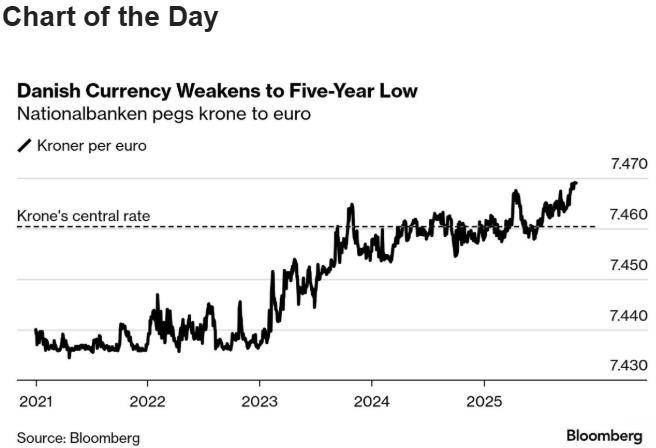
- The Danish krone has weakened to its lowest level since 2020, which may prompt the country’s central bank to step in to defend the currency’s peg to the euro. Economists say the krone’s depreciation against the euro stems from a mix of factors, including government investments and weaker foreign appetite for Danish equities. If pressure persists, the central bank may opt to raise its key interest rate independently of the ECB or use foreign- exchange interventions to prop up the currency.
- Airbus is keeping its ambitious jet delivery target, this year,
CEO Guillaume Faury told Bloomberg Television, as the aircraft manufacturer reported strong quarterly earnings. The France- based company expects to hand over about 820 aircraft to customers this year despite delivering just 507 through September. “We are fully prepared; I think we are going to have the engines we need,” he said.
- China opens Door to Rare Earth relief. Four Indian companies have won Beijing’s approval to import rare earth magnets, signalling an easing of the Chinese grip. The Chinese commerce ministry has approved the export applications of Jay Ushin Ltd, De Diamond Electric India Pvt. Ltd., and the Indian units of German automative component maker Continental AG and Japan’s Hitachi Astemo. This relaxation comes with a condition that India will not export them to the US nor use them in India’s Defence Sector. The decision comes as a major relief for Indian auto-makers and electronics manufacturers. About 30 applications from India-based companies are still awaiting approval from China
- Crippled refineries in Russia and the advancing winter in Europe are expected to pump up demand for Indian petroleum products till the end of March’26. The Indian refineries may be in prime position to tap the demand, given that they have expanded their crude oil
sources over the years, and completed scheduled annual maintenance. September’25 witnessed India’s highest export of petro-products so far in FY26 at 6.18 million tonne, Diesel exports to Europe hit a 19 months high of 291,000 bpd in September, the highest since December 2023, and this robust demand is expected to continue in months ahead. The Russian refineries would require a few months to completely revive operations. Private entities like Reliance Industries Ltd and Russian owned Nayara Energy are the major exporters of petroleum products in India.
Baltic News 30th October, 2025 BALTIC INDICES 30/10/2025
DRY INDEX: 1983 (+22)
| CAPESIZE | INDEX: | 2945 (+102) |
| PANAMAX | INDEX: | 1849 (-36) |
| SUPRAMAX | INDEX: | 1336 (-6) |
| HANDYSIZE | INDEX: | 855 (-7) |
BCI TC AVG $/DAY 24428 (+848)
BPI82 TC AVG $/DAY 16643 (-319)
BSI TC AVG $/DAY 16890 (-76)
BHSI TC AVG $/DAY 15382 (-140)
TIMECHARTER
‘Yasa Pioneer’ 2006 82849 dwt dely Dhamra 28 Oct trip via EC India redel China $18,500 – Akij
‘Nina Petrakis’ 2023 82444 dwt dely PMO 27 Oct trip via EC South America & Iran redel PMO $20,000 – Bunge
‘Shine Coral’ 2024 82352 dwt dely Haldia 29 Oct trip via EC South America redel Singapore-Japan $18,250 – Oldendorff
‘Rosco Poplar’ 2008 82331 dwt dely aps EC South America 22 Nov trip redel Singapore-Japan $17,250 + $725,000 bb
‘Maia’ 2009 82193 dwt dely Ulsan 6/8 Nov trip via EC Australia redel Singapore-Japan $17,250
‘Navios Star’ 2021 81994 dwt dely Hong Kong 2 Nov trip via Indonesia redel South Korea $20,000
‘BBG Honor’ 2015 81917 dwt dely Fangcheng 2/6 Nov trip via Indonesia redel Japan $19,500 – MOL
‘Tong Xiang’ 2020 81607 dwt dely Hazira 3/4 Nov trip via South Africa redel South Korea $17,000 – KLC
‘Explorer Oceania’ 2015 81073 dwt dely Taichung 3/5 Oct trip via Indonesia redel South China $17,500 – Tongli
‘Kona Trader’ 2007 76596 dwt dely Kunsan 6/8 Nov trip via NoPac redel Singapore-Japan $15,500 – Cargill
‘Epicurus’ 2005 75395 dwt dely Busan 30/31 Oct trip
via NoPac redel Singapore-Japan $15,500 – Pan Ocean
‘Bei Yuan’ 1998 74694 dwt dely Hong Kong 6/10 Nov trip via Indonesia redel South China $16,000
‘Berge Rysy’ 2025 63923 dwt dely Ilo Ilo prompt trip via Indonesia redel Thailand $16,250 – Oldendorff
PERIOD
‘Glorious Sky’ 2015 81893 dwt dely Hong Kong 5/10 Nov 5/8 months redel worldwide $15,500 – Bunge
VOYAGES ORE
‘Oldendorff TBN’ 180000/10 Saldanha Bay/Qingdao
21/25 Nov $17.65 fio 90000shinc/30000shinc – Ore and Metal
‘Swissmarine TBN’ 170000/10 Sudeste/Qingdao 23/28 Nov $23.55 fio 100000shinc/30000shinc – Usiminas
‘TBN’ 160000/10 Port Hedland/Qingdao 13/15 Nov
$9.50 fio 80000shinc/30000shinc – FMG
‘TBN’ 160000/10 Port Hedland/Qingdao 15/17 Nov
$9.50 fio 80000shinc/30000shinc – BHP
MISC
‘Darya Lachmi’ 2022 Koch relet 70000-72000 mop Vancouver/Bayuquan & Tianjin 23/27 Nov $23.50 fio 9000sshex/7000sshex – Canpotex
CAPESIZE
A broadly positive tone carried through today, with gains recorded across both basins as the BCI 5TC advanced by $848 to $24,428. In the Pacific, activity was steady with two miners, two tenders, and several operators contributing to healthy demand, while brokers noted a light tightening in the tonnage list. Offers on C5 began in the high $9.00s, and fixtures were eventually concluded around $9.50, nudging the index up by 0.190 to $9.515.
Across the Atlantic, sentiment also improved with increased demand reported from South Brazil and West Africa to China. Bids on C3 for index dates were said to be around $22.50, with offers between $23.75 and $24.00, leaving a gap yet to be bridged. In the North Atlantic, tonnage appears thinner, supporting firmer trans-Atlantic fixtures, while talk of stronger front-haul activity continues, though without any fixtures reported so far.
Atlantic
Usiminas fixed last night a Swiss TBN for 170,000/10 Sudeste to Qingdao 24/28 November at $23.55. Mirabulk fixed a Oldendorff TBN for 160,000/10 Drummond to Rotterdam 15/24 December at $13.90.
Asia
BHP fixed a TBN for 160,000/10 Port Hedland to Qingdao 15/17 November at $9.50 and FMG fixed a TBN, linked to Marmaras for 160,000/10 Port Hedland to Qingdao 13/15 November at $9.50.
PANAMAX
A continued softening in the Panamax market was evident, with the BPI timecharter index posting a $319 decline to settle at $16,643 upon publication. The Atlantic basin remained under pressure, with limited support across all loading areas. The southern region presented a mixed outlook, with rates varying widely depending on laycan spread and date sensitivity. In Asia, sentiment was equally fragmented. Reports indicated that while some charterers managed to secure fixtures at lower levels, others encountered resistance from owners opting to hold firm.
There were pockets of improvement ex-Australia, but both NoPac and Indonesia continued to underperform as the week ended. Period news included reports of the Glorious Sky (81,893 2015) Hong Kong 5/10 November fixed basis 5/8 months at $15,500 with Bunge, whilst the Pisti (81,737 2021) Nansha 2/10 November was rumoured fixed basis 5/7 months at $16,000 with Klaveness, whilst the W-Smash (82,742 2013) Kashima 7 November was heard fixed for short period at $14,000 but little else emerged.
Atlantic
Much of the activity reported was focused on the south with reports of the Rosco Poplar (82,331 2008) delivery aps EC South America 22 November fixed for a trip redelivery Singapore-Japan at $17,250 +
$725,000 ballast bonus, whilst Oldendorff recently secured the Shine Coral (82,352 2024) Haldia 29 October for a trip via EC South America redelivery Singapore-Japan at $18,250.
Asia
In the North came rumours of the scrubber fitted Acra (82,031 2016) Qingdao prompt was heard fixed for a grain NoPac round but further details remained scarce, whilst ASL Bulk were rumoured against the Calipso (73,691 2005) Gunsan prompt for a grain NoPac round too, but rate details remained under wraps.
SUPRAMAX
A similar story to yesterday although some brokers said a bottom had been reached in the US Gulf and spoke of stronger numbers being achieved, having said that no actual fixtures surfaced. From the Continent, some felt that the recent scrap demand had eased slightly and there was talk of lower numbers being discussed.
The South Atlantic again lost ground as tonnage levels remained relatively high. The lacklustre feel from the Asian arena persisted as limited fresh enquiry was again seen in both the north and south. The Indian Ocean was a little more buoyant and some felt that demand had increased slightly from South Africa. The 11TC average closed down
$76 at $16,890.
Atlantic
The Doric Shogun (63,347 2016) open Brake 4 November was heard fixed for a trip with scrap basis delivery Ghent redelivery East Mediterranean at $24,000 with Baltnav.
Asia
The Royal (61,201 2022) was heard to have failed on a backhaul trip basis passing Singapore at $13,000 with split rate for Cigading to the Continent but no further details surfaced. Elsewhere, the Marianna (55,573 2010) which sailed Dahej on the 27th October and giving etc/d Richards Bay 9 November was placed on subjects at $18,500 plus
$185,000 ballast bonus to Sohar/Fujairah. It was also rumoured that an ultramax was fixed at $21,000 plus $210,000 ballast bonus for delivery Port Elizabeth trip to China with manganese ore, again no more details came to light.
HANDYSIZE
Another rather poor day for the sector. The Continent-Mediterranean lost further ground and brokers spoke of lower amounts of enquiry. The US Gulf again saw negative sentiment persist and tonnage list grew longer. There was a downward shift in sentiment from the South Atlantic, some saying there had been a sharp correction in enquiry.
From Asia, it remained finely balanced although some said that there was a tightness of prompt tonnage availability further north. The Cetus Beluga (43,413 2015) open Qingdao was heard to have been fixed at
$13,000 for a trip to Brazil but no more details came to light. On the period stage, a modern 40,000 open Continent-Mediterranean on
November dates was heard to have been failed for 4/6 months trading redelivery worldwide at $15,000 again no more details surfaced. The &TC average closed down $140 at $15,382.
Baltic Exchange Index – 30 OCTOBER 2025 Baltic Exchange Capesize 182 Index
Route Description Value Change
===== ========================================== ===
C8_182 182000mt Gib/Hamburg transatlantic RV 26,669 + 1300 C9_182 182000mt Cont-Med trip China-Japan 49,261 + 1233 C10_182 182000mt China-Japan transpacific RV 27,573 + 750 314_182 182000mt China-Brazil round voyage 27,909 + 1014 C16_182 182000mt Backhaul 10,278 + 228
=======================================================
C5TC 182 Weighted Timecharter Average 28,071 + 894
Baltic Exchange Index – 30 OCTOBER 2025
Baltic Exchange Capesize Index 2945 (+ 102)
Route Description Value($) Change
====== =================================== ========
| C2 | 160000mt Tubarao to Rotterdam | 11.406 + 0.162 |
| C3 | 160-170000mt Tubarao to Qingdao | 23.377 + 0.604 |
| C5 | 160-170000mt W Australia to Qingdao | 9.515 + 0.190 |
| C7 | 150-160000mt Bolivar to Rotterdam | 12.894 + 0.319 |
C8_14 180000mt Gibraltar-Hamburg T/A RV 23,094 + 1031 C9_14 180000mt Conti/Med Trip China/Japan 45,222 + 916
| C10_14 180000mt China/Japan T/P RV | 24,250 + | 668 |
| C14 180000mt China-Brazil RV | 24,491 + | 1123 |
| C16 180000mt N.China to Skaw-Passero | 6,528 + | 217 |
| C17 170000mt Saldanha Bay to Qingdao | 17.817 + | 0.528 |
========================================== ========
5TC Weighted Timecharter Average 24,428 + 848
Baltic Exchange Panamax 82500mt Index 30 OCTOBER 2025 Baltic Exchange Panamax Index 1,849 (-36)
Route Description Value ($) Change
====== ================================= ========
| P1A_82 Skaw-Gib T/A RV | 17,482 | – | 477 |
| P2A_82 Skaw-Gib trip HK-SKorea incl Taiwan | 24,430 | – | 429 |
| P3A_82 HK-SKorea incl Taiwan, Pacific/RV | 16,813 | – | 366 |
| P4_82 HK-SKorea incl Taiwan to Skaw-Gib | 10,056 | – | 97 |
| P6_82 Dely Spore Atlantic RV | 15,403 | – | 185 |
====== ================================= =======
P5TC Weighted Timecharter Average 16,643 – 319
The following routes do not contribute to the BPI or Weighted TC Average.
Route Description Value ($) Change
====== ================================= ========
| P5_82 S. China Indo RV | 17,144 – 234 |
| P7 66000mt Mississippi Rvr to Qingdao | 55.036 – 0.300 |
| P8 66000mt Santos to Qingdao | 38.307 – 0.286 |
Baltic Exchange Panamax 82 Asia Index – 30 October 2025
Route Description Size (MT) Value($) Change
===== ====================== ======== ======
P5_82 S.China one Indo RV 17,144 -234
Baltic Exchange Supramax Index – 30 OCTOBER 2025 Baltic Exchange Supramax Index 1336 (- 6)
| Route Description Value ($) Change ====== ========================================= | ===== | |
| S1B_63 Cnkle trip via Med or Blsea to China-S.Korea 22,558 | – | 30 |
| S1C_63 US Gulf trip to China-South Japan 26,468 | + | 268 |
| BS2_63 North China one Australian or Pacific RV 15,650 | – | 121 |
| BS3_63 North China trip to West Africa 13,620 | – | 140 |
S4A_63 US Gulf trip to Skaw-Passero 25,311 + 318
S4B_63 Skaw-Passero trip to US Gulf 14,039 – 182
| BS5_63 | West Africa trip via ECSA to North China | 21,071 | – | 143 | |
| BS8_63 | South China trip via Indo to EC.India | 16,975 | – | 271 | |
| BS9_63 | W.Africa trip via ECSA to Skaw-Passero | 16,861 | – | 185 | |
| S10_63 | S.China trip via Indonesia to South China | 12,643 | – | 164 | |
| S15_63 | Indian Ocean trip via S.Africa to Far East 14,658 + 100 | ||||
| ====== | ========================================= ===== | ||||
| S11TC | Weighted Timecharter Average | 16,890 – | 76 | ||
| S10TC | Supramax(58) Timecharter Average | 14,856 | – | 76 | |
Baltic Exchange Supramax Asia Index – 30 October 2025
Route Description Value($) Change
====== =============================== =======
S2_63 N.China one Austr or Pac RV 15,650 -121 S8_63 S.China via Indonesia/Ec India 16,975 -271 S10_63 S.China via Indo/S.China 12,643 -164
====== =============================== =======
S3TC Weighted Time Charter Average 15,162 -177
Baltic Exchange Index – 30 OCTOBER 2025 Baltic Exchange Handysize Index 855 (- 7)
Route Description Value ($) Change
| ====== | ======================================== | ===== | |||
| HS1_38 | Skaw-Passero trip Recalada – Rio de Janeiro | 11,829 – 71 | |||
| HS2_38 | Skaw-Passero trip Boston – Galveston | 14,521 – 115 | |||
| HS3_38 | Rio de Janeiro-Recalada trip Skaw – Passero | 21,333 | – | 539 | |
| HS4_38 | USGulf trip via USG or NCSA to Skaw-Passero | 21,564 | – | 336 | |
| HS5_38 | SE Asia trip to Spore – Japan | 14,286 | – | 28 | |
| HS6_38 | N.China-S.Kor-Jpn trip to N.China-S.Kor-Jpn | 13,006 | + | 12 | |
| HS7_38 | N.China-S.Kor-Jpn trip to SE Asia | 12,681 | – | 38 | |
| ====== | ======================================== ====== | ||||
7TC Weighted Timecharter Average 15,382 – 140
(c) Baltic Exchange Information Services Ltd., 2025
Marex Media
The Author
Mr Bansi Jaising – photo you have
All Rights Reserved “Disclaimer”
All Rights in material and information in this document is reserved. Any form of reproduction or distribution of the information contained in this by any means whether electronic or otherwise is expressly prohibited including distribution by re- producing it anywhere.
I do not guarantee the adequacy, accuracy, timeliness, and/or completeness of the Data or any component thereof or any communication (written, oral, electronic, or other format). The writer shall not be subject to any damages or liability, including but not limited to any indirect, special, incidental, punitive, or consequential damages (including but not limited to, loss of profits, trading losses, and loss of goodwill).
The data provided here is sourced from various news media, bulletins and reports from various sources to which I do not have any claim.
Any user of the Data should not rely on any information and/or assessment contained therein in making any investment, trading, risk management or other decision. You may view or otherwise use the information, prices, indices, assessments and other related information, graphs, tables, images in this Publication, at your own risk or consequences and is only for your personal use.